Showing posts with label Brumfield. Show all posts

27 June 2023

Thomas P. Jordan and Mary Elizabeth “Betty” Arden Jordan: Whispers from the Grave; Klaiber Cemetery, Boyd County, Kentucky


Compiled by Teresa Martin Klaiber 2023


Thomas P. Jordan was born between May 1868 (1900 census) and  Feb 1871 (d cert) in Lawrence County, Kentucky.  His tombstone says he was born in 1870.  He was the son of Absalom and Julia Ann Coburn Jordan[i].  His maternal great grandparents were Micajah and Eleanor Clay Brumfield[ii].

Thomas married Mary Elizabeth “Betty” Arden, 25 September 1892 in Lawrence County, Kentucky.  The family settled near Willard in Carter County, Kentucky.   By 1910 they are listed at Maddox. 

On 29 August 1925 the Jordan’s purchased a portion of the land now owned by the compiler and her husband.  The Jordan’s purchased the tract of 26 + acres from John Allen and Eula Bolt Hazlett[iii].   This portion of the land includes the original one room log home which was improved and the compiler’s husband grew up in. You can read The Log Cabin Heritage at Deliverance farm by clicking here.

Thomas and Betty were residing on the property in 1930 along with their youngest daughter’s Thelma and Dorothy. The Jordan’s took out a mortgage with the Federal Land Bank in Louisville and on 28 September 1932, with a transfer of $1.00, their son William Estill “E. W.” Jordan became the owner, taking over the loan. The deed reserved the right of Thomas and Elizabeth to live on the premises during they joint lives and the survivor “may” occupy the same until their death as well.  The road was called Poor House Road during this time frame. The county changed the name to Long Branch Road at a later date. 

On 16 January 1940 Mary Elizabeth Arden Jordan died of a cerebral hemorrhage[iv]. “Betty” was the daughter of Andrew Jackson and Elizabeth Taylor Arden, both born in Virginia.  She was buried in Klaiber Cemetery 18 January 1940.  Their son Hillman Bayes Jordan, (written about in a previous blog), was buried in Klaiber Cemetery August 1931. 

The 1940 census was taken in April after Betty’s death.  Thomas is shown on Poor House Road along with daughter Hermia and son-in-law Billy Fannin and children. Daughter Goldie and husband John D Fannin live in the next residence, beside James M and Julina (Sexton) Klaiber.

Eight months after Mary Elizabeth Arden Jordan’s death, Thomas P. Jordan married Elma DeVore Davidson 23 September 1940 in Greenup County, Kentucky[v]. He was 72 years old.  Thomas Jordan made another deed, with E. W. and wife Ethel Jordan, in Boyd County on 6 August 1941 stating that Elizabeth died intestate (without a will) and that T. P. Jordan has now remarried, Elma (as spelled).

The marriage with Elma was not without drama[vi].  An article appears in the Portsmouth Times on charges of Bigamy 5 Oct 1941, Greenup County: Mrs. Alma (as spelled) Jordan 48 was arraigned today before Judge Jacob Fisher on a charge of bigamy filed by her husband Thomas Jordan who claimed that he married her in Greenup September 23, 1940 and that she was already married at the time. The charge was dismissed by Judge Fisher on grounds of insufficient evidence.”

Thomas and Alma/Elma seem to have resolved their differences.  They were remarried in Lawrence County, Ohio 22 October 1946.  The license states that he resides at Ponds Run, Ohio and is divorced.   Elma age 56 as of 14 January was born in Bluefield, Wet Virginia, daughter of James and Maxine Sayra Devour and is also divorced.[vii]  Thomas is now 78 years old.

Estill William Jordan, son of Thomas and Betty Jordan was an accountant for Pure Milk Company, on Carter Avenue, Ashland, Kentucky.


On November 25 1944 Estill William and his wife sold the 26+ acres to John Henry and Elsie Ellis Rucker Klaiber[viii].  This was during a period when Klaiber was purchasing the partitioned lands of his grandfather along Poor House Road. John Henry was a great-great grandson of Micajah and Eleanor Clay Brumfield thus had “family ties” to the Jordan’s.  His maternal uncle Jasper Newton Sexton had previously resided in the cabin. 
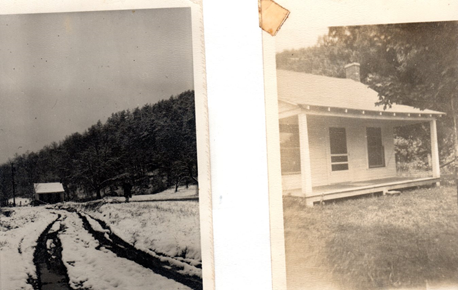


The log home with improvements 1940’s, Long Branch Road, Rush, KY


Thomas P. Jordan and, the widow of his brother David Taylor Jordan, Anna Jordan were living in Nile Township, Scioto County in 1950 along with Roy L. Jordan age 44, single.  Anna is widowed and Thomas P. Jordan is marked as separated.    The census margin reads “proceeding north from US 52 on Main on Left fork of Pond Run.” 

John and Elsie remained on the farm, on Long Branch Road, living in the house, they purchased from Jordan’s, with several remodels, during their lifetime.  Elsie called the original portion that was the one room log home her parlor, where she played hostess to guests.  Their only son James David Klaiber grew to adulthood on the farm. 

Thomas P. Jordan died in 11 July 1951 in General Hospital, Ironton, Lawrence County, Ohio. The information for his death certificate was provided by daughter Goldie Jordan Fannin.  The certificate states that his usual residence was Boyd County, Kentucky. He died from a cerebral hemorrhage and was buried in Klaiber Cemetery in Boyd County, Kentucky on the 13th.[ix]


The compiler always welcomes additional information to keep with the cemetery records books.


[i] Absolom and Juilia m 6 Jan 1860 Carter County, KY

[ii] Micajah Brumfield and Eleanor Clay m 15 Feb 1802 in Tazewell Co., VA

[iii] The Hazlett’s held title for five years

[iv] KY Vital Death Cert 158 Elizabeth Arden Jordan

[v] KY Grnp M bk 82 page 382 Thos gives his age as 69 she age 45, both reside at Rush, KY

[vi] Alma had married Boyd Adkins 28 Sep 1933 In Law Co OH as Elma Johnson

[vii] OH Law M cert 31988 volume 45

[viii] KY Boyd dbk 192-355

[ix] Oh Vital, Ohio Historical Society, Certificate  44693, volume 13034

29 October 2020

Little Children - Our Ancestors' Lives

 Compiled by Teresa Martin Klaiber 2020


Genealogists build the life story of their ancestors utilizing family stories, court records and more.  The children of the household may be counted in the family census records or even a guardianship.  But they rarely show up in other court records until they attain the age of consent.  Did our ancestorial children have happy childhoods? Were they well fed and properly clothed?  Genealogists can assume religious upbringing and possible wealth through their parents records but personality and other factors in life may be harder to ascertain.

Julina McCormack was born on Christmas Day, 1836 in Lawrence County, Kentucky. By looking at calendars we know that day was also the Sabbath, Sunday.  In early December, prior to her birth, Martin Van Buren was elected the 8th President of the United States.


Julina McCormack

Julina was the daughter of Lorenzo Dow and Emily “Emma” Brumfield McCormack.  Her father was born 11 October 1804 in Bedford County, Virginia and named for itinerant preacher, Lorenzo Dow.  An article, while Lorenzo’s mother, Mary, was pregnant, gives a clue as to why so many in Bedford county were named Lorenzo. “A brief account of the remarkable work of God, in Virginia, Bedford County, which originated at a Camp Meeting, held by the Rev’d Lorenzo Dow, in conjunction with eighteen Methodist Preachers … souls were …converted – with innumerable awakenings… …June 5, 1804[i].

Julina’s parents married 2 March 1826 in Giles County, Virginia.  Lorenzo Dow McCormack’s father-in-law to be, Micager Brumfield witnessed the marriage bond.  Lorenzo Dow and Emma Brumfield McCormack were married by Landon Duncan, a Baptist minister who the next year united with the Disciples of Christ Church.  Their first child, Ellen was born 25 December 1827, their first Christmas baby, in Giles County, Virginia.

There are several family stories handed down about Julina’s mother, Emma.  Some family members were told that Emma and sister Lucinda were Cherokee and either adopted or raised by the Brumfield Family. This is a fallacy, disproved by DNA.  This compiler’s husband has no native blood and over 100 dna matches showing that Micager Brumfield is the father of Emma. 

Another family story told this compiler says Emma was killed in a corn crib by Creek Indians in North Carolina and her husband (Lorenzo Dow McCormack) then brought the children to Kentucky after her death.  This also is a fallacy.  Emma/Emily is accounted for on her husband’s census in Giles County in 1830 along with a female child under five (Ellen) and a new son Micajah (named for his grandfather Micajah and called Cager).  There is a published story in the History of Tazewell County about the capture of the Andrew Davidson family along with a bound boy and girl “orphans whose parents were Broomfields.”  However, this incident occurred in the Spring of 1791 and both Lorenzo and his wife were not born until the early 1800’s. While this story may be connected to the Brumfield family it does not directly involve Julina’s mother.

Lorenzo and Emma did not own property and they may have been in financial trouble when an indenture was drawn up to Charles and Daniel Hale in September 1831, in Giles County, Virginia.  The other possibility is the McCormack’s were preparing to migrate to Kentucky and needed money, not material items. The indenture involved a debt of $45.75, Lorenzo, signing by mark. McCormack put up 44 shocks of hemp, one cow and calf, a two year old heifer, 12 hogs, two beds, furniture and all household and kitchen furniture.  Charles Hale was infirm and exempted from working the public roads the same year.   

What is clear is that early in 1832 Emma had another baby boy James Madison McCormack born in Giles County, Virginia and Lorenzo’s father also had a debt. Father Dennit McCormack signed an agreement, in September, with David and Andrew Johnston for $30.00.  Among the articles in the debt indenture was a “little wheel” (spinning). 

Lorenzo’s father, Dennit McCormack, died sometime before August 26, 1833 in Giles County. Among his inventory is a flax wheel, one loom and one set of spools.  Lorenzo’s mother, Mary/Polly retained the spinning wheel from the sale.  Lorenzo, Emma and the children had already begun their roughly 218 mile trek to Kentucky.  Lorenzo Dow McCormack appears on the 1833 tax list in Lawrence County, Kentucky, where they have another baby boy in March 1833, named Lorenzo Dow McCormack Jr.

Settled in Lawrence County, Kentucky, after three years, 25 December 1836, Julina McCormack was born.  The second Christmas baby born to the family.   There is no further record for Emma/Emily Brumfield McCormack after the birth of Julina. 

Emma’s parents had also migrated from Tazewell County, Virginia to Lawrence County, Kentucky.  Julina’s grandfather, Micajah Brumfield, died just a month short of Julina’s first birthday, 28 November 1837.  This is also the last appearance of her father, Lorenzo Dow McCormack, on Lawrence County tax rolls. 

Julina’s sister, Ellen, nine years her senior, was bound out to learn the trade of spinstress in February 1839.  She was bound out to uncle, James Brumfield.   This hints that her mother was not around to guide her.

Julina, a toddler, was 2 ½ years old, when father, Lorenzo Dow McCormack married a second time to Winna Bolling, across the river, in Lawrence County, Ohio, 26 September 1839.  I do not locate L.D. in 1840. But this compiler believes that Ellen, Julina, and Lorenzo are among the children listed in their grandmother Eleanor Clay Brumfield’s household during the census in Lawrence County, Kentucky.  She was probably under Eleanor’s care since the death of her mother. The family resided on the East Fork of Bolts Fork.    A court order in March 1839 describes the Widow Brumfield’s property in a county road order: “Widow Brumfield’s up the fork to the Carter County line.” Other records indicate the property very near Sandy Furnace.  This is all beautiful bottomland until it reaches the hill approaching Carter County.

Julina’s grandmother, Eleanor Clay Brumfield,  was cited as owner of cattle that family herded to Wabash, Illinois in 1842[ii].  Among other family members involved in a suit against Eleanor Brumfield was William McCormack, Julina’s uncle.  While the suit does not mention Julina’s father a lot of family was involved.  I usually think of cattle drives out west, but an excellent and informative read appears in Agricultural History, April 1954 titled Cattle driving from the Ohio Country, 1800-1850.  I now visualize them taking the cattle across to the Vincennes Trail, earlier known as the Buffalo Trail, to Wabash where cattle were bringing top dollar during this timeframe.

Sister Ellen again appears in a court record citing Peres Randall as her guardian 26 January 1846 stating that father Lorenzo Dow McCormack is deceased. Ellen is 18 and can chose her own guardian. Randall was a well- known physician in Lawrence and later Boyd County. Julina had lost both her parents by the time she turned nine years old.  Her life during this period is a mystery. I have not located a guardianship or apprenticeship for her or her other siblings. 

Step-mother, Winna Bolling McCormack, remarries 14 December 1845 to, German immigrant, Henry Osendott, in Lawrence County, Ohio. This suggests that Julina’s father died before December 1845. The Osendott’s are living in Vernon Township of Scioto County, Ohio in 1850. Julina’s  brother, James Madison McCormack, is residing with Ellen now married to Harvey Slusher, in Lawrence County, Kentucky.  Brother, Lorenzo Dow Jr. is residing with grandmother Eleanor Clay Brumfield along with cousin Malinda McCormack[iii], in Lawrence County, Kentucky. Neither Julina, now 14 years of age nor her brother “Cager”, age 20, is accounted for in 1850.  Either the census taker has slaughtered the spelling of names or they were not counted as members in a household which presents a conundrum.

The Osendotts had son Pleasant Osendott in 1851, in Ohio. He moves to Twin Branch, Lawrence County, Kentucky and dies in 1914 in Carter County, Kentucky.  Winna also has a daughter, Nancy, in 1852 in Kentucky.  By 1870 she is back in Lawrence County, Ohio.

Julina married Henry Powell Sexton in Carter County, Kentucky 2 March 1854.  She was 17 years old.  She like other members of the family learned and loved to spin. 


Julina McCormack Sexton spinning, Sophia Francis Crum[iv]and Henry Powell Sexton carding wool.

She would bare ten children all born in the portion of Carter that became Boyd County.  Her youngest child, a daughter, Julina Leota Sexton Horton Klaiber gave me her mother’s old spinning wheel which I cherish.


Julina McCormack Sexton developed pneumonia and died January 14, 1914. She is buried in Sexton Cemetery on Pigeon Roost, Boyd County, Kentucky.[v]

I often think of Julina McCormack Sexton's childhood. Especially those years between the age of 4 and 17. Formative years.  She taught daughter Julina all the things needed keep a household sufficiently.   The children of our ancestors had to be resilient, able to adapt to changes in circumstances and self-sustaining.


[i] Carlisle Weekly Herald, 20 Jun 1804

[ii] Phoebe Anne Hale Webb, Lawrence County, Kentucky Annotates Abstracts Of Circuit Court Records 1821-1873 (McDowell Publications: n.p., 1984), Page 17.

[iii] d/o Wm and Lucinda Brumfield McCormack

[iv] Sophia Francis Crum b c 1892 d/o Henry Wiser Crum and Maggie Klaiber.  Sophia d c. 1894 and is buried in unm grave Klaiber Cem.

[v] KY, Boyd D Cert 311, 1914. Age 77.1.20

04 May 2015

Deliverance Farm Cabin Antiques

Log Cabin Heritage at  Deliverance Farm

 This article originally appeared on our webpage at deliverancefarm.com.  Because of illness and unstable posts this is duplicated from my web page.  I will continue to maintain this blog as long as my health allows.uue to maintain the Eastern Kentucky Genealogy Blog as long as my health will allow.      The  
Restoration on the old farm house at "Deliverance Farm" Boyd County, Kentucky began in 1998.  We utilized PermaChink - a grit based silicon mixture that adjusts to shifts in temperature and log expansion and shrinkage.    We have also treated all the logs for "critters," gone over the stain and sealed the logs.

The front room is traditional square log dating to about 1867.  Originally part of the old Howe farm, the Klaiber's purchased this portion of the farm from the Jordan's in 1944.  [See  annotated title search below]

The room is complete with fireplace and hardwood floors.  Memories of Christmas trees, parlor chats, and candy pulling fill the air.  While the front porch is not original it comes complete with two swings - and we invite our friends to visit and sit a spell.    Renovation discoveries have included an unknown window tucked beside the fireplace and initials H and H  W carved   on the left side of porch.  Additionally the name JEB is carved just to the left of the entrance door.  Chinking varied from the original mud and horse hair packed mixture to the 1930's popular "repair" chinking of  cement.

The house was heated with a coal stove, in the added middle section, from at least 1932 until 1971.  It was covered with redwood siding and trim which helped protect the home from varmits.  In 1971 the house was remodeled and aluminum sided. Typical of most early farm homes, the structure was added on as needed.  The 1932 newspapers used as a barrier between log and newer structure and as "padding" for wall paper give clues to the addition of the middle portion between log structure and kitchen and cellar.  This is a good indication that originally there was a dog trot to the cellar area.

                            A Little Bit of History

On the 3rd day of  September 1866 W. P. Hood  and Matilda   his wife sold, their son-in-law, James W. Howe and Sarah his wife,   in consideration of $1.00, a tract of  land described as laying on Salmons fork of Garner, being a part of the survey of Richard Graham, deceased [Boyd County dbk   3:274]. This is one of several tracts now a part of Deliverance Farm, owned by James and Teresa Martin Klaiber.  William P. Hood was the son of  Thomas and Sarah Hood, early settlers of what was then Greenup County, Kentucky.   He was born 2 March 1805 and died 14 August 1874.  He married 13 December 1831 Matilda Howe born 3 December 1805 died 20 March 1887, buried in Klaiber Cemetery. William P., according to historian Evelyn Jackson also had a son named   Price by one of his slaves.

As the Civil War  came to a close,  James W. Howe and Sarah E. Hood Howe [born about 1839]   sold Phillip H. Howe,  December 18, 1867 this portion of the property [Boyd County dbk 7:123] and  we surmise  it was Phillip and his family that first lived in this cabin.  The 1870 Federal Census shows Phillip age 24, Sarah 56 [his mother], Martha K. 32, Sarah 21, George W. 19, Matilda 17 and a Wesley  Bellding 18 being enumerated on East Fork.  His mother Sarah [nee Fannin married George W. Howe  20 Oct 1836 in Lawrence County] died in 1874 and is also in Klaiber Cemetery.

On  19 December 1879 Allen Prichard purchased the property  with the deed giving the description as between Long Branch and Sammons Fork [Boyd County dbk 9:54].   In 1893 he deeded the property to his daughter Hellen S. Finley.  The property stayed in the Prichard family until August 1909 when S. H. and S.D. Finley sold the land to Jasper Sexton [Boyd County debk 57 page 417].
Jasper Newton Sexton [born 15 January 1869 died 10 November 1967] was the son of Henry Powell Sexton and Julina McCormack Sexton.  He married Miriam Robert Lambert 20 January 1898 in Boyd County.  They with their tiny son Royal Norman born 30 November 1899 moved into the cabin.  Through the years the following children were also born while living there:  Willa B. 10 December 1902, Everet born 8 June 1904, Thomas Edgar born 28 June, Sophia Mae born 9 March 1910, Harold Lee born 18 December, Maymie Lynd born February 1917, Wirt Elam born 18 July 1918 and a stillborn infant in February of 1916.   On January 22, 1920 Jasper sold the property and home to J.A. Hazlett [Boyd County dbk 77:604].

John Allen Hazlett was born 24 April 1892 and died 9 December 1959.  He married Eula D. Bolt born 20 November 1895, the daughter of Kent and Bertha Mae Pope Bolt.   J.A. and Eula owned the property for 5 years selling to T.P. Jordan and wife Elizabeth on 29 August 1925.  At the time of the sale the description referred to the ridge between Long Branch and Solomon Fork.  Thus there is a question about the proper name of the fork - Salmon, Sammons, Solomon [Boyd County deed book 106:90].

Thomas P. Jordan born abt. 1870 was the son of Absolom Jordan [s/o Pleasant] who married Julia Ann Coburn .  Julia was the daughter of  Thomas Coburn and wife Julina nee. Brumfield  Julia's grandparents were Micajah Brumfield and Eleanor Clay Brumfield.  Elizabeth Jordan died 18 January 1940 and Thomas remarried.  On November 25, 1944  son E.W. Jordan sold the property to John Henry Powell Sexton Klaiber and wife Elsie Rucker Klaiber [Boyd County dbk 192 page 355], adding the tract to additional lands in the family.  John Henry was the great great grandson of Micajah and Eleanor Clay Brumfield and thus had "family ties" to the Jordan's.   John Henry was the son of  James Matthew Klaiber and wife Julina Sexton Klaiber.  Julina was the sister to Jasper Newton Sexton who previously resided in the cabin.    John and Elsie remained on the farm, having remodeled the home, until their deaths.  Elsie loved antiques and referred to the original cabin which was now the front room as her "parlor"  where she played hostess to guests.  Their only son James grew from infancy to adulthood on the farm and now [2015] retains the deed to the property.

In the Fall of 2013 the Klaiber's opened the cabin doors selling country antiques.  Renamed Deliverance Farm Cabin Antiques the "shop" is open each Saturday May - October from 9am til 4.  You are welcome to come browse, pet our donkeys and sit under the wonderful huge maple trees.

11 June 2010

Sandy Furnace And It's People

compiled by Teresa Martin Klaiber 2010

For many years I have collected tidbits about Sandy Furnace. During a conversation with Ann Sutherland the other day, she mentioned she could recall standing at the John D. Ross Cemetery, and possibly see Sandy Furnace when she was a child. I closed my eyes to visualize the scene and together we decided if you climbed to the highest point just beyond the cemetery and looked down into the bottom lands, with the foliage gone, you probably could see remains of Sandy Furnace.

With the sun gleaming, today, I decided to see just how far the old Furnace was from John D. Ross Cemetery, located on Route 773, more commonly known as Bolts Fork Road to us locals, at the edge of Boyd County. By the road it is exactly 2.8 miles from the cemetery gate to Sandy Furnace located at 23330 Bolts Fork Road. While standing in the sun and humidity my mind began mulling over why the Kentucky Historical Marker was over 3 miles away from the actual furnace. I turned around and drove the meandering beautiful bottom farm land of Bolts Fork to Route #3 where the historical marker has been placed on the main thoroughfare. I am sure they meant well by putting it where most traffic would pass. Over the years I have practically memorized the wording knowing that besides placement of the sign, there was a much larger story.

Furnaces were prevalent in Greenup County and the northern edge of Boyd County and scattered in Carter County. But Sandy Furnace is tucked on the southern edge of the county far from the other producing furnaces. When built it was still in Lawrence County, Kentucky. Much has been written about area furnaces but very little has been compiled on Sandy Furnace. The longest general description was written in Donald Rist's publication Iron Furnaces of the Hanging Rock Iron Region in 1974. Rist had done a little more research than is posted on the Historical marker but gives the same simple basic information that the furnace was built in 1853 by Young, Foster and Company which included Dan and John Young, William Foster and Irwin Gilruth.

Interestingly both the historical marker and Rist lead one to believe that Sandy Furnace ceased operation in 1854 or shortly thereafter. This was not the case. Nor do these tiny blurbs give the general reader the feeling of just how many people in the community were involved or benefited from the Furnace. I can stand on the ridge of our farm nearly 5 miles away and see the indentations in the woods where ore was dug out. If I close my eyes I can imagine the oxen sledding the ore over the ridge, following the creek, struggling up and over Jack and finally arriving at the furnace.

The Geological Survey of 1856 talks about the ore beds being one hundred and five feet higher in the hills. It does not talk about the distance or the many farms that were tapped for the ore. According to the Survey Sandy Furnace was producing seven tons of iron in twenty-four hours and was then hauled to a depot at Catlettsburg and was "twenty-two miles, by the course of the stream, above the mouth of the East Fork of Little Sandy."

The planning and building of Sandy Furnace began in 1848. When John and Daniel Young of Hamilton County, Ohio began with mortgages on the tract of lands on Bolts Fork. William A. Foster and his son Henry were witness to the transactions. William A. Foster along with Theodore Royer began the task of buying up right of ways, timber and ore for the execution of an iron furnace. The deeds are a roll call of those families living at what would shortly be called Sandy Furnace, complete with its own post office. Lawrence County deeds were executed with Henry Morris, Thomas Coburn, William Messer, Madison Stewart, William McCormack, Ellis Taylor, William Brumfield, John D. Ross, James Prichard, William Webb and James Stanley.

John Foster had six sixteenth, Dan two sixteenth, William A. Foster three sixteenth and Irwin Gilruth three sixteenth interest in the furnace.

William A. Foster was already settled in Lawrence County and is not to be confused with William Foster, just several years his elder, who was working at the furnaces in Greenup County. Both were from Pennsylvania.

William A. Foster was settled in Lawrence County prior to the formation of Sandy Furnace. He ran for town trustee in May 1846 in Louisa but appears to not have stayed in town long. William Ely writes about William A. Foster in his Big Sandy Valley. Ely stated that William A. Foster had come to the area with a Pennsylvania Company and is "favorably known in Catlettburg" and had "first made his appearance in Sandy as store keeper for the company." The 1850 Lawrence County, Kentucky census shows William A. as a merchant along with his family including Henry who is listed as clerk and Irwin Gilruth giving occupation as a merchant from Ohio.

Theodore Royer was living in Hamilton County, Ohio in 1850 having married Elizabeth Young. He gave his occupation as a merchant and was also born in Pennsylvania. They migrated to Ann Arbor Michigan and in 1880 he gave his occupation as a retired manufacturer. Mrs. Louie Lovett [DAR #15022], Elizabeth Royer Slauson [DAR 14364], and Adaline Katharine Gross [DAR 14363] were all lineal descendants from the Royer and Young family.

Foster sold most of his interest to Young in 1850 and by 1860 was comfortably living in Catlettsburg listing his occupation as a clerk, owning property. By 1870 he lists his occupation as a retired dry goods clerk.

John Young and his wife Caroline never lived in eastern Kentucky. In 1850 They sold all their interest in Sandy Furnace to William Moore Patton which gave Patton controlling interest. Patton was born in 1803 in Huntingdon County, Pennsylvania. He had been involved in Vesuvius Furnace in Lawrence County, Ohio and Pennsylvania Furnace in Greenup County. He settled in Catlettsburg and the Patton's went on to own many varied concerns in the area.

Rist tells of the fall of the furnace stack in the summer of 1853 and advertisements in the Ironton Register for 25/26 stone cutters at the furnace. The 1856 Geological Survey talks of coarse sandstone which was over lower limestone "employed as hearth-stones for the furnace." By the time of WPA days there is only one known actual rock quarry in Boyd County located on this compiler's farm. Driving along the bottom land of Bolts Fork I am sure there are many hidden areas that were chiseled out and now overgrown.

By the time of the 1856 survey Patton had sold his controlling interest to William Wurts then of Hamilton County, Ohio. William along with several brothers were also from Pennsylvania and had interest in several area furnaces. A biography of William Wurts was published in Kentucky, A History of the State in 1888. Wurts lived until 1876 and died in Mason County, Kentucky.

The furnace was still active in 1859 when The Iron Manufacturers Guide to Furnaces and Forges...was written by Lesley. Lesley describes that Sandy Furnace makes a very liquid iron from the ores and that the bed was about 5 feet under sandstone "high in the hills" regarded as the "highest workable bed in Carter and Lawrence."

My active mind understands that these powerful manufacturers came into our area and created a living beyond the small poor farming interests. Some stayed like Foster and Patton. Some left legacies in our area and across the river in the iron region of Ohio.

It was hard labor intensive work from the cutting of timber to the digging of ore. The feat of hauling the raw goods to the furnace and the final product taken to the terminals had to be grueling. Stone masons were needed and furnace hands were in demand, animals had to be maintained, all of which helped put food on the table in the Bolts Fork area. A community was created and the deeds that purchased the timber and ore rights are more descriptive than any other historical local document of the time.

The furnace is fallen in now, hidden by a modern home built directly in front of it. Standing in the sun in the middle of Bolts Fork Road, quiet all around, not a person in sight, yet the history is so loud I can hear it. Close your eyes maybe you can share the view with me.


08 February 2010

Treasure Chest Thursday - Sexton Spinning Wheel


Pregnant with my first child in 1971, Julina Leoto Sexton Horton Klaiber said she was "heiring me" her mother's spinning wheel. I was in the early stages of my genealogical journey. Julina told me her mother had brought it from Virginia to Kentucky with her. Over the years the spinning wheel would move with us from Ohio to New Jersey, back to Ohio before finally returning to Boyd County, Kentucky & the farm where it had been a functional household item. As tiny boys, my sons all learned how to get a rhythm with the pedal to make the wheel go round. A spinning lesson in New Jersey added to my appreciation of pioneer ingenuity.


Julina Leoto Sexton Horton Klaiber lived to 100 years of age and was buried in Klaiber Cemetery in 1978. She was born 30 June 1877 in Boyd County, Kentucky to Henry Powell Sexton and wife Julina McCormack Sexton. One day my mother-in-law produced a picture of Henry Powell & Julina McCormack Sexton. What a serendipty moment. Not only was I able to see these wonderful ancestors, I was looking at Julina using the spinning wheel while her husband was carding the wool. A look at the Carter County, Kentucky tax records for the late 1850's show that the Sexton's did own their own sheep.


Like most family stories there are few questions remaining. "Mamaw" [Julina Sexton Klaiber] had stated that her mother brought the spinning wheel from Virginia. Genealogical documentation shows that her mother was born and raised in eastern Kentucky. Julina McCormack was born in Lawrence County, Kentucky, Christmas Day 1836, the daughter of Lorenzo Dow McCormack and wife Emily Brumfield. Her parents were from Giles County, Virginia having settled in Lawrence County by 1833. Julina's husband Henry Powell Sexton was born in Virginia 24 April 1835. His father Marcus Sexton had migrated through Pound Gap into Letcher County and the family migrated northward to a portion of Carter County that would become Boyd County, Kentucky.

The photograph is easy to date. The child in the photograph is Julina Lorraine Sexton born 15 August 1907, daughter of Henry Powell Sexton [II] and wife Katherine Allen. By her size the photograph appears to be taken about 1909. Henry Powell Sexton [I] died 24 September 1912. His wife Julina McCormack Sexton died 14 January 1914. Both are buried in Sexton Cemetery, Pigeon Roost, Boyd County, Kentucky. The information I have gathered about the small wheel is that it was manufactured in the 1800's and may have been called a "Naomi."