Showing posts with label Scioto County. Show all posts

07 October 2023

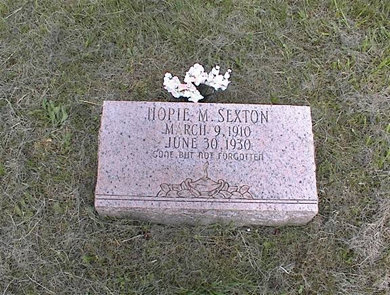
Sophia Mae “Hopie” Sexton: Whispers from the Grave; Klaiber Cemetery, Boyd County, Kentucky


Compiled by Teresa Martin Klaiber


Sophia Mae “Hopie” Sexton was born 9 March 1910 in Boyd County, Kentucky. She was the daughter of Jasper Newton Sexton and Mariam Roberts Lambert Sexton.  Whenever family remembers and talks about her she is simply “Hopie.”  Her father’s nickname was “Hop.”

Hopie went to Portsmouth, Ohio and was working as “forelady” for a steam laundry company when she was eighteen.  When she and her friends went to the river to swim and cool off. Tragedy struck.   Hopie drowned in the Ohio River on June 30, 1930, when she was twenty.  

The Portsmouth Daily Times told the sad story. “…Found near foot of Harmon Street where she met death Monday night -Companions rescued. Zelda Lowder of Bluefield and Everett Harlowe 12 have close call.  Strangled by waves from a ferry and a barge ...Miss Hopie Sexton 20, of 2334 Jackson Street, was drowned in the Ohio river...occurred about 300 yards west of the upper ferry landing...body was recovered...by city firemen.  about 20 minutes after the victim disappeared the rescue squad of the city fire department hooked the body and lost it as it neared the surface. The body was later recovered near the same spot which is close to the place where she went down...Miss Sexton is the fourth drowning victim here this month...Zelda Lowder and Everett Harlowe were saved by the girls father C. L. Lowder. John Wall 17...Clarence Johnson 19...Nobel Sadler 21 ...Charles Lemon 35 of 2334 Jackson Street cousin of the drowned woman....others....were bathing  in the river near the scene when the drowning occurred and went to the rescue...Miss Sexton came here from Cannonsburg, Kentucky south of Ashland, Kentucky about two years ago. She was employed in the American Steam Laundry. For the past two months she had been living with her cousin Mrs. Charles Lemon[i]. Previous to that time she resided on Glover Street.  She is survived by her parents Mr. and Mrs. Jasper Sexton, three brother, Edgar, Harold and Mert[ii] and one sister Billie[iii] all of Cannonsburg …”

Hopie Mae’s death certificate[iv] simply states “Accidental drowning” “Drowns while in River.”   Her brother Thomas Edgar Sexton was the informant for the death certificate.  Thomas became a pastor for the Church of God in Boyd County, Kentucky.

The Ashland Daily Independent was either given incorrect information or confused the death.  On July 2 the paper stated that Hopie Mae Sexton had died at her home after an illness of several days.  If this were the only article, researchers would incorrectly think Sophia “Hopie”  Mae Sexton died in Kentucky, which would be an error. The family brought Hopie back to Boyd County, to be buried in Klaiber Cemetery on 3 July 1930. 


[i] Mrs. Charles Lemon maiden name Bertha French was a 2st cousin once removed through her mother’s family.

[ii] Mert is an error – the brother ‘s name is Wirt Elam Sexton

[iii] Billie in the article is Willa Bertran Sexton. Her nickname was Bill.

[iv] OH Vital, Scioto 38680

02 March 2020

Wagon Maker Heinrich Gorath


By Teresa Martin Klaiber, 2020


My mother remembered German spoken in the house, as a child.  Mary Helen Feyler Martin was born in 1921.  She was 18 when her grandmother Anna Katherine Gorath Halderman died in Portsmouth, Scioto County, Ohio 19 June 1939.

The Gorath’s left a small treasure trove of official documents to help tell their immigration story.  Anna’s father Heinrich (Henry) Gorath was born 22 June 1829[i] [ii] in Wusting, Holle, Osterburg (Oldenburg) Germany, the son of Johann Heinrich Gorath and Anna Elizabeth Kroog.  His baptism is recorded in the Holle kirchlich and when fourteen he was confirmed in the same church.

His parents dutifully had him vaccinated for smallpox the 24th August 1830[iii], at one year of age. Smallpox vaccine had been established for decades.  By the 1830’s towns in Germany had sanitary police.  Schoolmasters, master craftsmen, servants and apprentices were requested to only accept vaccinated persons.[iv]

At the age of 18 Heinrich began keeping a small booklet, or day book, dated Oldenburg 1847.  His designs for sleds and wagons are a joy to look at.


Heinrich Gorath in possession of compiler 2020

Heinrich Gorath served in the 3rd Battalion where he asked permission to marry in October 1853.  Four months later he received a permission after learning the trade right, from the Kirschpiel, to master the trade of wagon maker.


With his life in order, Heinrich married Anna Marie Holman in the Kirschlich Oldenburg 19th April 1854.  He duly recorded a simple one line note in the back of his day book about his marriage.  Flip the page and the birth of baby Anna is carefully noted as 3 April 1855.  About midway in the book at a bottom of a page is the last date – he simply wrote “Marie Gorath Oberhausen 1857”.

Oberhausen translates to “upper house” and I have wondered if Heinrich was trying to get cabin passage for them when the family migrated to America.  During the early 1850’s  Germany was having an industrial boom but what comes up comes down and the bubble went bust in 1857 with a financial crash. 

His last official act in April 1857 Heinrich was to receive an honorable discharge from six years of military service.   The discharge gives a wonderful description of Gorath.  He was 6 ½ feet tall, his eybrows dark, a high forehead, grey eyes, ordinary mouth and nose, uneven teeth, oval chin, a round face, healthy and a scar on his left hand thumb.

Now with small baby Anna Katherine, and his wife’s widowed mother, Anna Catherine Neumann Holman, they paid passage on the barke Rastede.  There were 226 passengers along with the Captain H. A. Kahle.   A barke is a sailing vessel with three or more masts.  The barke may have been named for the village Rastede which is 12 kilometers north of Oldenburg.  It was built in 1852 by Oltmann’s at a town, near Bremen named Brake.  It was said to have two forward square-rigged masts and a rear mast rigged fore-and-aft.[v]

The family embarked at Bremen.  Among the passengers were eight children under the age of eight which would have included two year old Anna.  The Gorath’s did not pay for cabin passage and are listed as between deck, passengers 219-222 on the manifest whish was submitted by the captain upon their arrive in New York.[vi] The New York Times reported the barke was cleared on July 3rd.  

When the couple celebrated their Golden Wedding Anniversary, Gorath gave an account of their voyage. The Wellston Telegram  wrote on 26 April 1904:
 “…Mr. Gorath’s account of their voyage would frighten the twentieth century traveler. They were seven weeks coming across, taking passage on a sailing vessel. At one time when almost in port they were blown out to sea and three weeks passed before they sighted land again. They came direct to Portsmouth and from there to Jackson county. Later they settled at Berlin, where for thirty years Mr. Gorath has been the village wagonmaker…”
Seven weeks between decks with a toddler and elder.  Yet today we complain about cramped seats on jets that cross the world.  They had a destination.  They came directly to southern Ohio because Heinrich Gorath’s, brother-in-law, Hermann Heinrich Hollman had already established themselves.  Hermann Holman and Anna Marie Holman Gorath were children of Johan Heinrich Hollman (1795-1857) and Anna Catherine Neumann Hollman who travelled to America with the Gorath family. Hermann Henry Hollman/Holman was a shoemaker born in Wusting, who with wife, Isabella Katherine Mittendorf, had settled at Pine Creek, Bloom Township, Scioto County, Ohio.

Scioto and Jackson county are noted for furnaces.  Jackson county was not lacking in work and wagons were needed to haul coal, ore and fire clay.  There was plenty of work for Gorath.   At least two Bituminous furnaces are listed in Berlin Cross Roads.

The family settled at Berlin Cross Roads.  Heinrich dutifully registered for the Civil War draft. On July 17, 1863,  John Hunt Morgan was on the march with Ross county militiamen chasing them.  Two Confederate scouts sent into Berlin Cross Roads were shot.  By noon it was over.   It did not deter Heinrich Gorath in October he filed his naturalization in Scioto County.[vii]

Mother-in-law Anna Catherein Neumann Hollman died in March 1867 and was laid to rest at Monroe Furnace, Jackson County, Ohio. By the 1870’s Heinrich/Henry Gorath is well established with his shop in Berlin Cross Roads.  Daughter Anna Katherine Gorath married Dr. Stephen Simpson Halderman 28 August 1873 at Berlin Cross Road, Milton Township, Jackson County, Ohio. By 1875 Gorath is listed as a manufacturer of all kinds of carriages and wagons, with special attention given to repairing.[viii] A simple sign on the shop reads “H. Gorath Wagon Maker.”[ix]


The family lived happily at Berlin Cross Roads until after the death of Anna Marie Holman Gorath, 16 February 1908.  She was buried in South Webster Cemetery.  In March the Portsmouth papers report Henrich Gorath is ill and now residing with his son (in-law) S. S. Halderman at 826 Gay Street, Portsmouth, Ohio.  “venerable Mr. Henry Gorath…continues ill in bed …gaining ..in strength …His old home in Berlin, made desolate by the death of his life partner, the late Mrs. Gorath, has been broken up, and the household goods sold-excepting articles the family desired to keep, and among which is some quaint furniture from the native place of the Gorath’s Germany.”[x]

My 2nd great grandfather died 11 March 1909 in the home where my grandmother and mother were born, where family passed from this life, and many patients were tenderly treated.   Venerable Citizen Answers Last Call…contracted a severe attack of the grip, which gradually superinduced serious complications…passed away peacefully at the home of Dr. and Mrs. S. S. Halderman where he was tenderly cared for…”[xi]

I cried when the beautiful brick home at 826 Gay Street had to be torn down in the 1970’s. The bricks were crumbling and could not be saved.  But the whisper of so many voices in that house still linger.  I am 70 now and my mother gone.  I don’t want to be the last to tell the stories. 


826 Gay Street, Halderman Home demolished, late 1970’s.  Still Standing can be seen the outline of attached dental office between Halderman and Feyler Home. Shortly after the Feyler Home was also demolished.  Today both properties are parking lot.  But the carriage house still remains.  Carriages that were repaired and possibly even built by Heinrich Gorath.


[iii] Vaccination Certificate, James & Teresa Martin Klaiber Family Artifact Collection; privately held by Teresa Martin Klaiber, [address for private use], Rush, KY 41168. Carried on ship to America - original. From Stephen Halderman Home, Gay St., Portsmouth, OH to Mary Helen Feyler Martin to Teresa Martin Klaiber.[iv] The History of Smallpox Vaccination in Germany: A First Step in the Medicalization of the General Public. Journal of Contemporary History Vol 20 #4 Oct 1985 p 617-635[v] Breener & Bonne, The Steffen, Brandt and Euler family histories…p. 138. 1999.
[vi] New York Passenger Lists 1820-1897, microfilm publication M237 (Washington, D.C.: National Archives, ), 175, Arranged by date; Rastede, 1 July 1857, .[vii] 1863 Oct 8 NATURALIZATION: Scioto Co Oh FC Searl Judge
"...of Oldenburgh...emig from Bremen on 4 May 1857 DI from Jackson
Co Ohio 30 Jul 1860 ae 31. Jnl 2 208 {NAT PAPERS OF SCIOTO CO Ohio,
Portsmouth Public Library, Gallia St., Portsmouth} and original document possession of compiler
Gorath notebook item 32
"...of Oldenburgh...emig from Bremen on 4 May 1857 DI from Jackson
Co Ohio 30 Jul 1860 ae 31. Jnl 2 208 {NAT PAPERS OF SCIOTO CO Ohio,
Portsmouth Public Library, Gallia St., Portsmouth} and original document possession of compiler
Gorath notebook item 32
"...of Oldenburgh...emig from Bremen on 4 May 1857 DI from Jackson
Co Ohio 30 Jul 1860 ae 31. Jnl 2 208 {NAT PAPERS OF SCIOTO CO Ohio,
Portsmouth Public Library, Gallia St., Portsmouth} and original document possession of compiler
Gorath notebook item 32
"...of Oldenburgh...emig from Bremen on 4 May 1857 DI from Jackson
Co Ohio 30 Jul 1860 ae 31. Jnl 2 208 {NAT PAPERS OF SCIOTO CO Ohio,
Portsmouth Public Library, Gallia St., Portsmouth} and original document possession of compiler
Gorath notebook item 32
"...of Oldenburgh...emig from Bremen on 4 May 1857 DI from Jackson
Co Ohio 30 Jul 1860 ae 31. Jnl 2 208 {NAT PAPERS OF SCIOTO CO Ohio,
Portsmouth Public Library, Gallia St., Portsmouth} and original document possession of compiler
Gorath notebook item 32
"...of Oldenburgh...emig from Bremen on 4 May 1857 DI from Jackson
Co Ohio 30 Jul 1860 ae 31. Jnl 2 208 {NAT PAPERS OF SCIOTO CO Ohio,
Portsmouth Public Library, Gallia St., Portsmouth} and original document possession of compiler
Gorath notebook item 32
"...of Oldenburgh...emig from Bremen on 4 May 1857 DI from Jackson
Co Ohio 30 Jul 1860 ae 31. Jnl 2 208 {NAT PAPERS OF SCIOTO CO Ohio,
Portsmouth Public Library, Gallia St., Portsmouth} and original document possession of compiler
Gorath notebook item 32
[viii] D. J. Lake, Atlas of Jackson County, Ohio (Philadelphia, PA: Titus Simmons & Titus, n.d.), Berlin Business Directory.[ix] Berlin Xrd, OH, original photograph possession of compiler. 2020
[x] Portsmouth Daily Times 7 Mar 1908
[xi] The Daily Blade Mar 1909

[i] Gorath Auszug [Extracts] Kirchengemeinde kirchlich Oldenburg State Archives, privately held by Teresa Martin Klaiber, [address for private use]; Holle Page 109 Best 250-37 Bd. 2; , Evangelical Lutheran Church, Oldernburg, Germany
[ii] Birth Certificate, James & Teresa Martin Klaiber Family Artifact Collection; privately held by Teresa Martin Klaiber, [address for private use], Rush, KY 41168. Original hand written brought on ship from Germany. From Halderman Home, Gay Street, Portsmouth, Oh to Mary Helen Feyler Martin to Teresa Martin Klaiber.

10 October 2015

FAMILY HEIRLOOMS HAVE VALUE - MEMORIES ARE PRICELESS

Over the years we have attended many auctions.  Nothing tugs at my heart more than to see family members ruthlessly bidding against each other to purchase a treasured item at an estate sale.  In the heat of the moment it is often hard to remember that it is the memories attached to the item and not the item itself that we are clinging unto. 

Not all cherished items are antique or expensive.  In fact the most cherished keepsakes are often tattered, chipped and worn.  We have been married 47 years. Memories of my wedding and wedding showers flood back this week. 

The house in Catlettsburg, where my husband's aunts honored our marriage with a shower is now gone. Presents were deposited each gaily wrapped.  I could not help but notice that one present was wrapped in wrinkled paper and no bow.  The ladies would rearrange and kept tucking this package behind the more elegant gifts on display.

Finally the last present was handed to me.  I opened 4 pressed glasses, chipped and worn little dessert bowls.  Julina Sexton Horton Klaiber beamed and said "them is desert dishes" and went on to explain that she had used them many years and wanted us to have them. Julina was 91 years young that day.  I cherish them and use them every year especially during the holiday and smile each time I look at them.  No typographical error this lovely little lady called them desert dishes which makes me think of tropical sandy paradises that she never laid eyes on.


Among my treasures is the bisque cake topper from Howard Clayton and Katherine Marie Halderman Feyler's wedding that took place on 30 November 1918 in Portsmouth, Scioto County, Ohio.  It once had a dome to cover the bride and groom in period dress.  With the help of descriptive social page articles that announced the event I can envision the day.  It now is protected in the bow front cabinet in my living room. 


The bow front cabinet sat in the dining room of my grandparents on Gay Street when I was a child. It had gone thru the 1937 flood and was never refinished!  But with a few wood chips looks fine.  My mother said as the water receded they heard clanging and found a log moving back and forth hitting that glass.  It was not even cracked. My mother got it and took it to her home on Jomar in Ashland.  My parents brought it to me when we lived in Ohio.  As they moved it out the door a large table umbrella, propped up on the wall next to the door slid over and hit the glass.  Once again not even a chip to the glass.  I held my breath over the years with teen age boys thinking as the keeper of this wonderful piece I don’t want to be the one that damages the glass, after those stories!  Now my grandchildren peer thru the glass at the treasures.  Little hands leave finger prints that I hesitate to remove because it awes me that they are touching an item from their 2nd great grandparents that went thru the flood of all floods and survived!  My youngest son wants the cabinet and it will be his to continue the story.

A few years ago my husband carried my Ginny doll to an antique show; past many people and booths to have her restrung [I was unable to attend].  She is now whole again thanks to his time.  When I gaze at her I am transported back to a house long ago in Ashland, Kentucky and childhood memories come alive. I would sit cross legged in my tiny bedroom on Algonquin for hours dressing and redressing her. Mother taught me to take excellent care of any doll’s hair and today she looks like she did almost 60 years ago.

We have more valued treasures.  Hubby has his father's leather football helmet.  John Henry Klaiber played for a short time on an early Boyd County team.  We also have a picture of the team with him in helmet. 

Henry and Page Geer Martin's cherry gate leg table with several leaves hosted many family events. These included my great Grandmother Clara Geer until her death the year I was born in 1949, my father, uncle, cousins and friends.   Special events were documented with photographs.  My father was adamant that it be used in my house. It was a catalyst for his memories.  I am so thankful.  Now memories are being created around that table for a 6th generation and yes documented with photographs.

Will my descendants care about these physical items?  Will they have memories from sitting around our family table?   I hope so.


Estates are divided and sold.  Natural events destroy items.  But memories can be preserved.  Oral history pass stories and memories along.  Sometimes the stories are veiled by exuberant family members exaggerating to make the tale livelier as they are handed from generation to generation.   Not everyone can have the table but photographs can be digitized and shared so that each and every person in the family has a visual that will trigger their own memories. 

Just the other day I purchased a lot of books for winter reading.  I thought it was all novels until I found the priceless worn bible tucked among my reading material.  A beautiful story unfolded written in 1949. 

"Mrs. Joyce Stephens Feb 8, 1949 age 16. This bible was presented to me when I married Cecil M. Stephens. There was a $100.00 bill enclosed. My parents, Eva and Boyce McMillon gave all of us $100.00, if we did not smoke, drink alcohol nor coffe. I failed on the coffe. I used the $100.00 on supplies (lumber, etc) for our first home. Dad also gave us 2x4/s from his saw mill.  Trees were from the property on East Main (old Merritt property)."


Hubby and I could not let this wonderful bible story alone.  A little research showed that this lady lost her husband last year but was still living.  Obvious that after such a loss and cleaning out, the bible got lost in the shuffle.  I hit social media genealogy walls.  Within minutes I had 3 cousins from across the United States wanting that bible.  Within three days, one of the cousins, visiting from Florida was on my doorstep to retrieve it.  The joy of getting that bible back to family is beyond words or money. We never sell things like that even though we own a antique store Deliverance Farm Cabin Antiques.  We always try to get the item back to family members as a heart warming gift.

We are given the best device in the world to preserve memories.  The power of the written word.  Today we can combine that power with visual photography and sound bites.  Genealogy programs allow us to "attach" each digital item with the individual that once owned a physical item or was involved in the activity that created a special memory.

Yes, it is wonderful to have a physical item but so deeply sad if that item is fought over and family ties wounded. It is just stuff and we can't take it with us. But we can hold tightly to the memories.

07 March 2012

Jomar


Jomar
Compiled by Teresa Martin Klaiber
March 2012
When John Geer Martin was just a little boy he told his mother he had a dream. He was going to own a big horse farm.  He housed his horses in the detached garage by his house on Waller Street in Portsmouth, Scioto County, Ohio.  He went out to Scioto fairgrounds regularly. As he grew he knew that whatever he did it must involve horses. His father sent him to Blacksburg to VPI where he studied engineering.  But he really wanted to be with his horses. 

When World War II started he was one of the first to register.  He became a cargo pilot and flew the Hump.  His daughter and this compiler have all the letters he wrote home to his mother. Among them he told her he would name his farm “Jomar” for John Martin.  He could already visualize what it would look like.  He also acknowledged that engineering was not for him and that he truly wanted to be a veterinarian.   When the war was over, he went to Ohio State University, married, dabbled in journalism and finally with a DVM degree in hand moved across the river to Kentucky.

His wife, Mary Helen Feyler had made a childhood friend with a circus that had been in Portsmouth.  By the time they married she was taking him to meet her friends.  She often joked that his dream farm Jomar stood for John and Mary not just John Martin.  And over the next few years the network of circus associations grew along with his reputation as a circus animal doctor.

In 1961 the dream became a reality.  Martin  had purchased acreage in Boyd County, Kentucky at Cannonsburg.  With the help of his dear friend Michael Polakoff, aka Coco the Clown, they cleared the land.  I remember huge stacks of brambles and sticks and fires.  One of the funny incidences was when “Uncle” Mike was sent to get a tractor just down the road.  By dusk he was nowhere to be found and the call came “Doc I am in a town called Catlettsburg and I am lost.”  He had driven that tractor all afternoon when it should have been a ten minute ride. 


Painting by John Geer Martin
As the house was being built my father ordered brass plaques for the gates he designed.  JOMAR on one side and his name on the other.  His dream became a reality.  To celebrate he invited many of his circus friends.  It must had been the first time that the circus community knew he was calling the farm JOMAR.  They were quick to ask if it was named for John Ringling North’s circus car Jomar.  The car had been named for John and Mable Ringling.  My parents, surprised were quick to tell everyone their story and agreed it was a serendipity moment to tie his loves together.  The county named the newly graveled road Jomar Road.

For a while the train car was used by Rudy Bundy and in the 1960’s my father toured the “graveyard” of circus wagons and old trains rusting and off the track in Florida. There is a short grainy film he shot showing the burning of beautiful circus wagons and the train standing abandoned in the background.

Jomar in Boyd County, Kentucky was full of laughter, horses and circus friends
for many years.  Besides the wonderful saddle bred horses that we showed, several retired circus horses lived out their lives on Jomar.  Ringling boarded a beautiful stallion named Royal resplendent with his Kings Range brand.  Royal, retired from the circuit, lived out a happy life with our family.  Hanniford’s left two retired horses to pasture.  Robin who was notorious for scratching his huge back, breaking the fence, usually when my father was out of town; leaving mother to chatter away at him as he followed her back across where he belonged.  The second horse Sherry was a gentle white and my son John got the honor of taking a ride when he was small.

My husband and I were excited when an auction in the Zanesville, Ohio area advertised circus items.  Circus Fans came from all over to bid on what appeared to be mostly posters.  However, my eyes quickly found the familiar Jomar china in one lot.  I remember my husband and I wondering if Circus Fans would realize the value and history of the china but resolved we would add the items to Jomar in Kentucky.  As we began to bid I realized that the group was all looking my way.  Apparently, while I thought I was unknown, these fans knew Jomar and in honor of my parents nodded and did not bid. 

One of the items my parents did not have in the hodgepodge of china was any coffee cups.  Jennie Howerton, mother of Dr. Paul Savage, in Ashland, Kentucky matched the burgandy lettering color perfectly creating a set of six porcelain cups.  While a bit more dainty than the heavy original Jomar china it is a nice addition.

This is not genealogy but is the provenance of something that our family treasures and is as much a part of our history as our lineage.   The provenance of artifacts in history are as important as the people who utilized them.

Today Jomar in Kentucky sits quietly, in need of fence repair and laughter.  My father passed away in 1999.  My mother is still matriarch at Jomar but Alzheimers has stolen her memories. There is talk of restoration of the Ringling rail car Jomar that was in such disrepair so many years ago and its history is well documented.  

The history of Jomar in Kentucky and the legacy my parents left will continue.  My father loved many things in life including flying and journalism.  When he retired from veterinary medicine he decided to write. He wrote two war histories and two books about his life as a veterinarian.  Doc My Tiger’s Got An Itch tells a few of the many tales he had as an assistant veterinarian with Ringling and as veterinarian of many other small shows including Mills Brothers now also only a memory. So many beloved friends – human and animal. 

Our first son is named for his grandfather.   John’s wife is Marina.  Serendipity!  Jomar lives on.